Blog Posts
What is Perfect Binding?
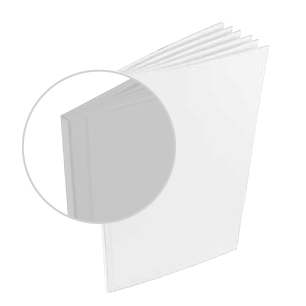
Perfect Binding
The spine or the book is cut and roughened, adhesive is applied to the rough edges and a cover is glued firmly in place. Bleeds and crossovers are also handled differently on perfect bound books.
 Advantages
- Versitile
- Overall look and visual appeal
- Printable spine
- Longevity
- Ability to creatively interleaf pages
Limitations
- Doesn’t lay flat. Not suggested for applications in which hands-free reading isimportant [e.g. cookbooks, technical guides, directories or instruction manuals].
- Minimum thickness of 1⁄8″ inch needed if spine is printed or1⁄16inch if spine isn’t printed.
THE PROCESS
- Folded signatures or single leaves are gathered into a stack.
- The spine side of the stack is milled to remove the folded edges, and roughened toexpose the paper fibers. The edge of each page is left exposed.
- Hot melt adhesive is applied along the spine edge of the book. The glue does notpenetrate; it flows around the exposed fibers.
- The cover is applied to the spine while the glue is hot. It is then pressed onto thespine, and wrapped around the book block.
- Hot melt dries in 2 to 25 seconds.
- The book is run through a three knife trimmer to trim the face, the head and the foot.
What is Spiral Binding?
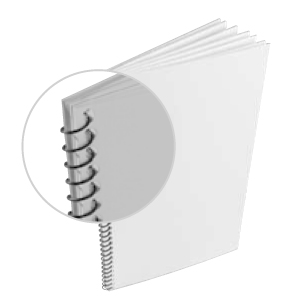
Spiral Stitching
To bind using a spiral of continuous wire or plastic looped through punched holes.
 Advantages
- Versatile & widely available
- Almost any material can be punched and bound, including paper, plastic and laminates.
- Lays flat.
- Ability to creatively interleaf pages.
- Finished piece folds over 360 degrees [useful for technical and reference applications].
- Well suited for short runs.
- Can accommodate grain short and most paper weights.
Limitations
- Not as sturdy as double loop wire.
- If the wire is crushed, it will not return to its original shape.
- Pages will jog when open and pages will step up when turned. Crossover designs willnot align.
- Wire ends are left unfinished; may snag or pull.
THE PROCESS
- Holes are drilled or punched.
- Continuous spiral wire is fed into the holes sequentially.
- Wire is crimped on both ends to prevent unravelling.
What is Side Stitch Binding?
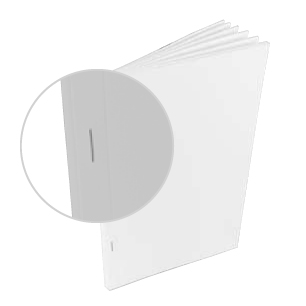 Side Stitching
Stapling the signatures together on the side rather than the fold.
Advantages
- Versitile & widely available
- Almost any material can be punched and bound, including paper, plastic and laminates.
- Lays flat.
- Ability to creatively interleaf pages.
- Finished piece folds over 360 degrees [useful for technical and reference applications].
- Well suited for short runs.
- Can accommodate grain short and most paper weights.
Limitations
- Not as sturdy as double loop wire.
- If the wire is crushed, it will not return to its original shape.
- Pages will jog when open and pages will step up when turned. Crossover designs willnot align.
- Wire ends are left unfinished; may snag or pull.
THE PROCESS
- Loose pages are collated and assembled into a stack.
- The loose pages are stitched or stapled parallel to the spine.
- When binding signatures, the head, foot and face of the book are trimmed.
What is Finish Size?
It is the overall size of the printed piece in its completed, folded or bound form.